
Bespoke is not a price point. It is not a marketing term. It is a process — specific, demanding, and irreplaceable. This is what it means, and why it matters.
The Word That Lost Its Meaning
Somewhere along the way, "bespoke" became a luxury badge — a word affixed to products that bear no resemblance to its origin. Walk through any shopping district and you will see the word printed on tags, displayed in windows, and whispered in sales pitches. But for every garment that claims the title, perhaps one actually earns it. The true meaning of bespoke has been buried under decades of marketing, and it is time to excavate it.
The word originates from Savile Row in the 19th century. A gentleman would visit his tailor, select a fabric, and have a garment constructed entirely for him — from nothing, on a blank piece of paper. The cloth had been "spoken for" — bespoke — by that individual client. It was singular. It was his. No pattern existed before he walked through the door, and none would exist after. This is the origin we honour at Regal Stitch, and it is the standard we refuse to compromise.
A Process, Not a Product
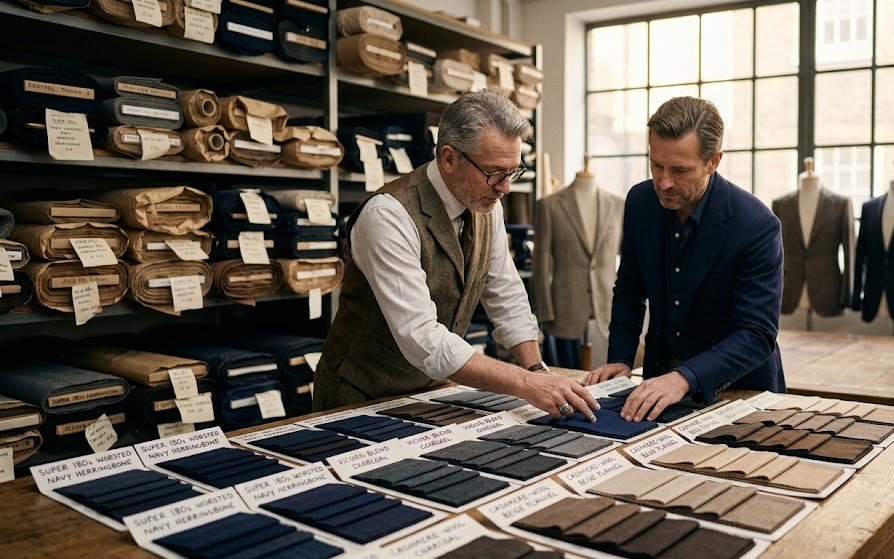
Bespoke is best understood as a sequence of irreplaceable steps — each one performed by hand, each one dependent on the last, and each one tailored to a single human body. It cannot be shortcut. It cannot be automated. It cannot be approximated. A bespoke garment begins with a conversation, not a catalogue. The tailor listens — to your posture, your profession, your preferences, and the way you move through the world. From that conversation, a pattern is born.
The Regal Stitch Principle
We do not begin with a standard block and adjust. We begin with a flat piece of paper and a single set of measurements. Every curve of the pattern, every angle of the lapel, every millimetre of shoulder extension is drafted by hand — for one client, one garment, one purpose. This is the definition of bespoke, and we will never dilute it.
The Hand-Drafted Pattern
The pattern is the soul of a bespoke garment. In made-to-measure and ready-to-wear production, patterns are derived from pre-existing blocks — standardised templates that represent an average body shape. The tailor or factory then adjusts this block to approximate the client's measurements. This is adjustment, not creation. A bespoke pattern is drafted from scratch, using only the client's measurements and the tailor's interpretation of their posture, proportions, and aesthetic desires. It is drawn by hand on pattern paper, with French curves and rulers, and it exists for one client alone. If the client returns in five years, a new pattern is drafted — because bodies change, and a true bespoke pattern is never reused.
What a Hand-Drafted Pattern Accounts For
- Shoulder slope and neck angle — ensuring the collar sits flush without gapping
- Chest prominence and ribcage shape — creating the correct amount of suppression and ease
- Posture and spinal curvature — preventing the jacket from pulling or draping incorrectly
- Arm length and shoulder-to-wrist proportions — placing buttons and vents precisely
- Seat and thigh shape — ensuring trousers hang cleanly without pulling at the waistband
- The client's preferred silhouette — slim, structured, relaxed, or somewhere in between
Floating Canvas Construction
The internal architecture of a bespoke jacket is invisible, but it determines everything — how the garment drapes, how it ages, and how it moves with the wearer. In mass production, the chest piece is fused: a layer of adhesive interfacing is heat-pressed to the outer fabric, creating stiffness through glue. This is fast, cheap, and ultimately brittle. The adhesive degrades. The chest piece yellows. The jacket loses its shape within two to three years.
In a bespoke garment, the chest piece is made from horsehair canvas — a resilient, breathable material that is hand-pad-stitched to the chest of the jacket. It is not glued. It is sewn, with thousands of tiny stitches that give the canvas its shape. Over time, this canvas moulds to the wearer's body, becoming more personalised with each wearing. The floating canvas allows the fabric to drape naturally, without the stiffness of adhesive, and it will outlast any fused garment by a decade or more.
The Basted Fitting
Perhaps the most defining moment in the bespoke process is the basted fitting — a stage that exists in no other form of garment production. After the pattern is drafted and the fabric is cut, the tailor bastes the garment together with temporary white stitching. The client tries on this rough, unfinished version of the jacket. It is deliberately imperfect — seams are visible, linings are absent, buttons are missing. But the shape is there, and the tailor can see everything: how the shoulder sits, where the waist falls, how the chest drapes, whether the hem is level.
The basted fitting is where bespoke becomes personal. It is the moment the garment begins to belong to one person — and no other person on earth could wear it.
At Regal Stitch, the basted fitting is a conversation. We examine the garment in motion — you sit, you walk, you raise your arms. We listen to what the fabric tells us, and we make adjustments by hand. After the basted fitting, the garment is returned to the atelier for a second round of refinement. Only when the fit is perfected does the final construction begin. This two-stage fitting process is rare even among bespoke tailors, and it is the reason our garments achieve a level of precision that speaks for itself.
Hand-Sewn Details
The exterior of a bespoke garment tells a story that few eyes can read, but the trained eye sees everything. Hand-sewn buttonholes — each one cut and stitched individually, with a precision that machines cannot replicate. Pick stitching along the lapels — a subtle, decorative stitch that holds the edge clean and signals that the garment was constructed by hand. Hand-set sleeves — eased into the armhole with a fullness that allows natural movement without pulling or bunching. Hand-attached linings — sewn with enough ease to prevent any restriction of movement. These details are not decorative. They are structural, functional, and they are the signature of true craftsmanship.
Hallmarks of a Hand-Finished Bespoke Garment
- Hand-cut buttonholes with silk thread — each one slightly unique, each one perfectly executed
- Pick stitching on lapels and pocket flaps — visible only upon close inspection
- Hand-set sleeves with fullness — allowing the natural fall of the fabric
- Hand-padded lapels — giving the roll its soft, organic shape
- Hand-finished interior seams — bound or felled, never raw or serged
- Barchetta breast pocket — a curved, hand-shaped pocket that follows the chest's contour
Why It Cannot Be Mass-Produced
The bespoke process is fundamentally incompatible with scale. A single bespoke jacket requires between 50 and 80 hours of skilled labour — from initial consultation through pattern drafting, cutting, basting, fitting, and final construction. A single tailor can produce, at most, two to three garments per month. This is not inefficiency. It is the nature of the work. Every garment is unique, every body is different, and every adjustment requires human judgment. No machine can read the way a client stands. No algorithm can interpret the curve of a shoulder. No assembly line can replicate the decision of a tailor who has spent a lifetime learning how fabric behaves.
The Regal Stitch Standard
At Regal Stitch, we hold ourselves to a standard that is both traditional and uncompromising. Every garment is bespoke — not "almost bespoke," not "bespoke-inspired," but genuinely, technically bespoke. We draft every pattern by hand. We use floating canvas in every jacket. We conduct a minimum of three fittings for every suit. We finish every buttonhole by hand. We do this because it is the only way to produce a garment that deserves the name.
Our Commitment
We will never use the word "bespoke" to describe anything that falls short of the full process. We will never compromise construction for speed. We will never sacrifice fit for convenience. The garment that bears our name must be worthy of the tradition it represents — and the person who wears it.
The Regal Stitch Manifesto
- Every pattern is hand-drafted, from nothing, for one client.
- Every jacket is constructed with floating horsehair canvas — never fused.
- Every garment undergoes a minimum of three fittings before completion.
- Every buttonhole is hand-sewn with silk thread.
- Every client receives a bespoke pattern archive, stored for future commissions.
- We never use the word "bespoke" unless every one of these conditions is met.
Begin Your Bespoke Journey
Every garment we create begins with a conversation. Tell us about yourself, and we will tell you what is possible.
Book a Consultation